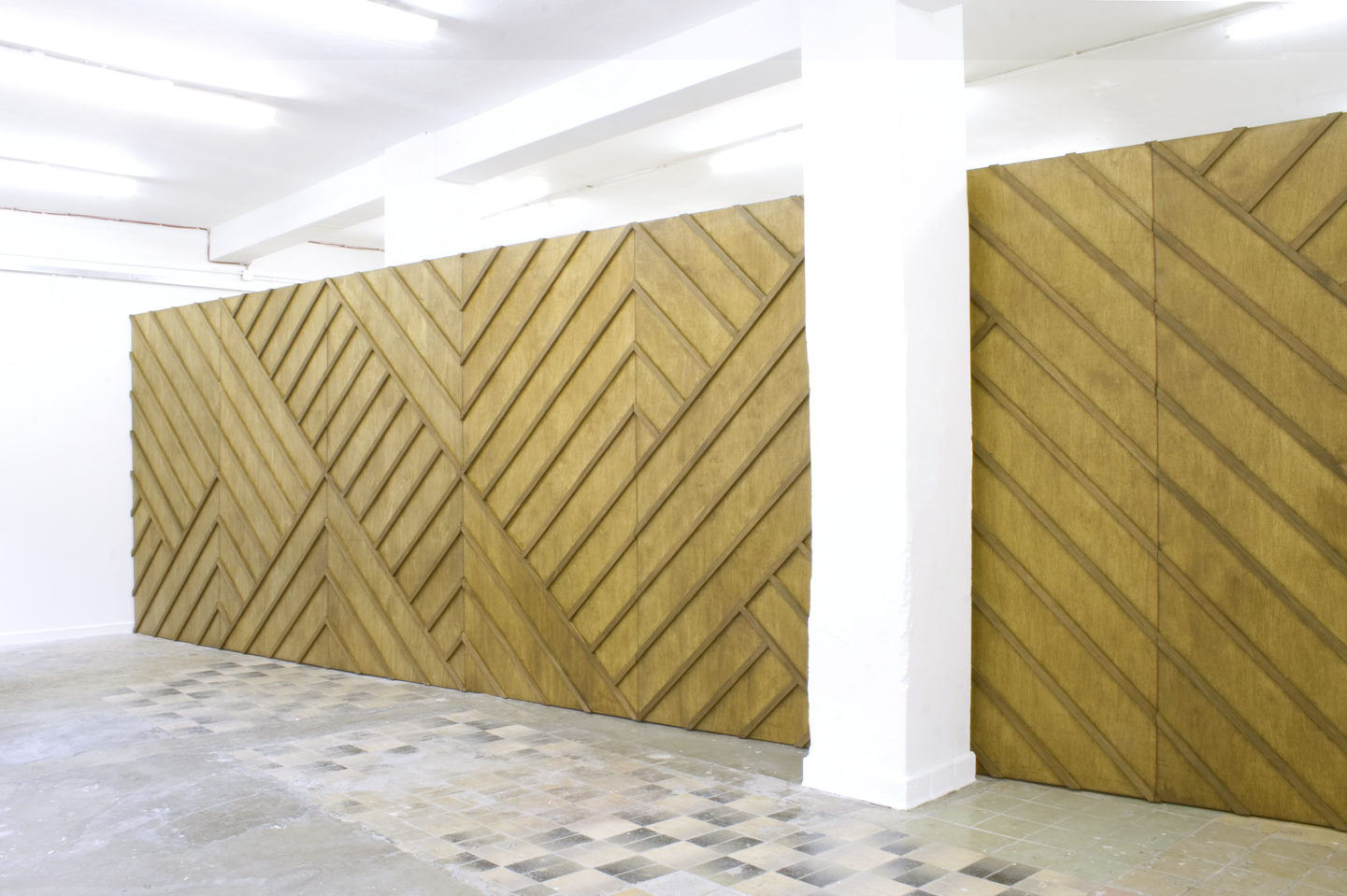

A discursive cartography of Borders, Boundaries and Barricades: Redeveloping Geographies of Division an exhibition by Ric Warren

BORDERS

Some questions to be completed by an Other:

[Nimis] Is there anything left to map, or only maps to revise?

A proposition to [Nimis]:

1.Can a map be considered a semiotic relationship between that over there, and this here. Or a reification of space. Expanded out to a diagram, of such a self-referential nature,  a map moves beyond an abstracting of the physical to solidifying the abstract. Consider 1982UJ,  the attempt to chart space  in homage to one who attempted to chart space/ a body known only through mathematics defined by the attempt to know space through language. Equally redundant and epitomising, a map is space – a space is a void – and a void doesn’t have much in it (it’s around we’re interested in).

2.

Lewis Carroll

The Hunting of the Snark, 1876.

He had bought a large map representing the sea,
without the least vestige of land.
And the crew were much pleased when they found it to be
a map they could all understand.

“What’s the good of Mercator’s
North Poles and Equators,
Tropics, Zones, and Meridian Lines?”
so the Bellman would cry,
and the crew would reply:
“They are merely conventional signs!”

“Other maps are such shapes,
with their islands and capes!
But we’ve got our brave Captain to thank,”
(so the crew would protest)
“that he’s bought us the best -
a perfect and absolute blank!”

3. Map of a thirty-six square mile surface area of the Pacific Ocean west of Oahu, 1967

4. Mapping can expand exponentially, and will be in constant shift – politically and geographically. New territories/space  will be mapped in new ways, some past will become relevant while others remain archaic. Mapping is the aesthetisisation of history’s parabola. Nothing can be too much.

[Arx] Are utopias built by walls?

[Omphalos] Which marks the centre and which the periphery? Can we de-centre?

In 1980, artist Lars Vilks constructed Nimis, a monumental structure consisting of 75 tonnes of driftwood on a peninsula off the coast of Sweden. When discovered by the Swedish authorities it was ordered to be destroyed for contravening building permits. Twice burnt and rebuilt, it was bought by Joseph Beuys in 1984 and subsequently, Jean-Claude and Christo; a second structure, Arx was erected successively. In an act of remonstration and to ensure the work’s continuance and autonomy Vilks declared the micronation Ladonia at the site of the sculptures in 1996, a state of nomadic citizens.

A third sculpture by Vilks Omphalos, a tonne of stone and concrete, was evicted from the site by authorities the same year as its production in 1999. Vilks later applied to the courts for permission to create a memorial to Omphalos at the site it had stood. Permission was granted based on the terms that it be no more than 8 centimetres high. The monument was consequently designed, built and inaugurated in 2002.

Ladonia has become a site for questions surrounding antagonistic and contiguous spaces; a transgressive and utopian space Ladonia holds a contradictory status, both in its dependence on, and autonomy from, existing authorities. It is only in its ‘otherness’ from the extant state, its declaration of separation, that it itself occurs or subsists.  Ladonia’s public spaces and structures exist in a fluctuant, precarious condition between fiction and substance; to enter their domain and (temporarily) become a citizen in their borders is to ascertain their potential as sites which are constantly in a process of change: transforming, reconstructing and disintegrating. Ladonia is less a nation-state than in a state of proposition – it is site as hypothetical space which pivots between the abstract and the concrete, a provisional riposte.

Despite its inherently ‘utopian’ proclaimed autonomy, independence and citadel like isolation there is something resolutely un-utopian (yet not dystopian) about Ladonia. Its crumbling architecture is built to occupy, not to be occupied – it populates the peripheries, both geographically (at the edge of a Swedish peninsula, surrounded by national parks) economically and politically (its ‘taxation’ being citizens ‘contributed creativity’). As a nation of ‘passers-by’ it is perhaps in its truest sense, a nation of tourists. Its status as city, artwork and visitor destination seem ensured with the establishment of the Ladonia Biennale in 2009.

As a verso to the recto of Ladonia, Sealand seems apt. Devoid of city, artwork and visitors (apart from the recently titled Ben Fogle) Sealand is an unrecognised micronation six miles of the suffolk coast –  geologically nowhere. With a Second World War sea fort and 60′s utopian ideals as bedrock, the history of Sealand has been a fraught one.


However, the awkward youth (see Princess Charlotte of Sealand)  and falling price tag aside. Considering our present preoccupation with Nimis, and the attendant Borders – what of a land with none, and no land to speak off. It might seem obvious that utopia a sea fort goes not beget, though would we not be hard pressed to find someone who doesn’t agree that isolation is the key. Separation is utopia, there needs to be someone who doesn’t get into utopia to make it utopia – even in metaphorical senses, one needs to thumb one’s nose at something.  We can’t get along.

King…

or,

…Dale

…And that is possibly an explanation rather than an elaboration. Though, to continue, why? Why are elements of separation so important in arcadian thinking, or rather, why can’t we stand the other? We just do. This separation is just an idealised border, as all are. The wall, islet or fort are needed as physical manifestations of our desires. That our ideas, appearance or beliefs are loftier than yours. Even if that means three generations living on redundant war apparatus. [tbc]

Echos of Ladonia seem present in the space of the exhibition. Warren’s forward slash rods, placed along the wall at equal integers derive from the slats placed on temporary walls around building sites to discourage fly-posting – his installations become an act of co-option within the exhibition space (‘built to occupy, not to be occupied’). The work’s modularity allows it to be expanded and added to or made smaller dependant of the given space it needs to occupy (because it feels like a need, rather than an option) and permits potential privatization, seizure, and engagement; its redaction is therefore liberation of space. Similarly to its minimalist referents, it is temporary, almost theatrical sculpture – its simplicity acknowledges the potential inscribed in the works constituent parts.

For Warren, the forward slash symbol further becomes a typographic tool with which to reference divisions and barriers in social space. Similar to physical walls forward-slashes can be used within punctuation to indicate a strong joint between phrases or, for Warren, an antagonistic ‘or’. Each of Warren’s ‘/’s then, come to represent a point of ‘option’ or ‘choice’ – repeated slashes running the length of the gallery walls become a prospectively endless demarcations of potential and temporality. Syntax becomes interpretive of site and graphic interfaces are strategies through which to navigate spaces of separation. Warren draws the dividing marks which set apart the (increasingly disarrayed) binary understandings of spatiality – work/play, cultural/useful, new/old, public/private.

Within the print series ‘Marks On Maps’, the ‘/’ is left floating, nearly invisible on a grid. Despite the cartographic references, its positioning is unclear and indistinct – there is a lost sense of orientation. The de-marking, or de-centring caused by this loss of orientation leads to a question; if there is no spatiality that is not organized by the determination of borders how do artists negotiate the articulation or delineation of dividing lines within a contemporary, liquid society?

Some terms:

Nimis; too much latin

Arx: fortress latin

Omphalos: navel greek named for stones set at ‘the centre of the world’ e.g. Temple at Delphi

BOUNDARIES

Mapping the distance between reality and the ideal; states of anxiety.

The following text is presented as a response to the notion of Utopia put forward in Jacques Rancière’s The Politics of AestheticsMore specifically I am responding to the following quote:

“[Utopia] is a word whose definitional capabilities have been completely devoured by its connotative properties.

Ashrita Furman has made a name for himself by both breaking and creating numerous world records as recognized by the Guinness Book of World Records.  Beginning in 1979, Ashrita has now broken over 250 records and currently holds over 100 records; one being the world record for “Most Guinness Book of World Records held by a single person at one time”. [i] The absurdity of these records has led many to criticize the value of both its attempt and successful completion.  This is due to Ashrita Furman’s disparate criteria for his practice, which can be anything from the purely physical act of completing 27,000 jumping jacks in one sitting, to the fastest peeled lemon in world.[1] In addition, while the actual execution of these records requires both discipline and skill, the significance of the attempt is often contested as absurd and evasive in terms of dealing with and addressing limitations.  For example, Ashrita not only holds the most records, he has created many of the records that he holds.  This is where Ashrita Furman is of interest to the topic of discussion; namely, how Ashrita Furman deals with obsolescence, spatiality, and potentiality in relation to touristic thinking.

Ashrita Furman is exemplary in suggesting infinite ways in which to illuminate human finitude or, in the words of philosopher Jean-Luc Nancy, able to touch upon “…a transcendental unpresentibility of that most concrete presence.” [ii] The spatial extension is produced both in his wake (the completed record) and the organization’s reception (a new or updated category) that become sites of ever more potential.  Put another way, while Ashrita is given power of extension through the creation and execution of a world record, the Guinness Book of World Records keeps the potentiality open through the retention of the accomplished record.  This results in the singular instantly becoming the potential for the plural, in this case, the success of Ashrita’s personal motivations simultaneously motivates any number of others willing to overcome this temporary marker. Unlike discourses where the “object” of resistance and contention essentially becomes elevated and negyle=”font-size: 10px; forman is unique to the discussion because the relationship he has with this force of resistance (the qualifying eye of the Guinness Book) is both visible and necessary.

The event of a successfully executed record, such as his October 2009 record of “T-shirt tearing while wearing”, is both an opening and a marker inside the spatial constraints of the Guinness Book of World Records.[2] In other words, the record is a poignant example of an obsolescent event aware of its closed opening and opened closure.  For Ashrita Furman, the invention of a record creates a temporary expansion within the confines of the legitimizing authority’s own logic.  By means of studying closely the finite credentials of what it is to make a record, Ashrita is endlessly able to construct legitimacy out of what appears to be strict, objective criteria.  In the same moment, the Guinness Book and the public as a whole, benefit from his expansionist adherence to the rules through which he creates a disruptive and enabling history.   Ashrita Furman’s practice can best be described as a nomadic wandering that produces only entrances in which others may participate.  The closure of Ashrita’s opening is that now anyone may legitimately participate in beating the now authorized record.

Past the innovations that established an almost modernist criterion such as technological invention and acts of bodily refinement, Ashrita Furman has fallen into a practice that becomes “occurent” and places the very form and logic of record breaking to the fore. The touristic potential of “homogeneity without universality” is found in the dilatant relationship it shares with temporality.[3] Jean-Luc Nancy’s emphasis on touch would best describe Ashrita’s “dis-closure” of the world.  Ashrita Furman preserves his successful absorption of his world and simultaneously keeps open the potentiality for others because he does not possess the act he preserves.  Nancy explains the act of touching as a sort of pushing when he says:

The world comes from its event.  It exists therefore right though – even though existence is not homogenous in itself, of man, of the stone, or of the fish.  There is only sense in touching that.  But in touching that there is only finite sense. vi


[1] The world record for the fastest time to peel and eat a lemon is 19.97 seconds set by Ashrita Furman (USA) at Guru Health Foods in Jamaica, New York, USA, on 24 April 2007.

[2] The world record for the most t-shirts torn while being worn in one minute is 15 set by Ashrita Furman (USA) at Guru Health Foods in Jamaica, New York, USA, in October 2009.

[3] I am using this term as its scientific description of a material that gains viscosity from exposure to stress.  Under low stress, dilatant materials act as a lubricant, while under heavy stress they begin to thicken and form mass (e.g. cornstarch).  This term was discovered by accident by misspelling the word “dilettante”.  However, I was amazed to find the similarity between these two terms since both speak of flux and retention implicated by an outside force.


[i] Ashrita Furman, Ashrita Fuman: Mr. Versitality, Vasudeva Server, 2009, http://www.ashrita.com/ (accessed Nov. 24, 2010).

[ii] Jean-Luc Nancy, Being Singular Plural, trans. Robert D. Richardson and Anne E. O’Byrne (Stanford, CA: Stanford University Press, 2000).

iii Jean-Luc Nancy, A Finite Thinking: Cultural Memory in the Present, ed. Simon Sparks (Stanford , CA: Stanford University Press, 2003).

[Nimis]

First, on a planet criss-crossed by ‘information highways’ nothing [can] stay in an intellectual ‘outside’. No terra nulla, no blank spots on the mental map, no unknown…Second, on a planet open to the free circulation of capital and commodities… nothing can be credibly assumed to stay in a material ‘outside’. Nothing is truly, or can remain for long, indifferent to anything else – untouched and untouching.

- Zygmunt Bauman Liquid Times: living in an age of uncertainty Polity Press, Cambridge; 2007 pp.5-6

[Arx]

Third principle. The heterotopia is capable of juxtaposing in a single real place several spaces, several sites that are in themselves incompatible. Thus it is that the theatre brings onto the rectangle of the stage, one after the other, a whole series of places that are foreign to one another… Fifth principle. Heterotopias always presuppose a system of opening and closing that both isolates them and makes them penetrable. In general, the heterotopic site is not freely accessible like a public place…To get in one must have a certain permission and make certain gestures.

- Michel Foucault. Of Other Spaces (1967). (“Des Espace Autres,” Architecture /Mouvement/ Continuité October, 1984. Heterotopia was the basis of a lecture given by Michel Foucault in March 1967. Translated from the French by Jay Miskowiec)

BARRICADES

Where the city is de-mapped and un-learned; the act of dismantling partitions ‘un-divides’ the city.

[essay to follow]

[Omphalos]

Fall arrives. Moscow cannot tolerate the reform movement any longer and decides to invade the country. By early September, half a million troops from the Soviet Union and four Warsaw Pact countries have marched into Prague. The Czechs, with neither arms nor funds, nevertheless mount a civilian resistance campaign against the invading army for eight months. They have nothing. And perhaps because of this, they fight the army in ways no one could imagine. There are, of course, the Molotov cocktails and human roadblocks. But what about the pornography (thrown at young and frightened soldiers patrolling the streets, to distract them from shooting at pedestrians) and the graffiti (like the one that reads, “Why bother to occupy our State bank? You know there’s nothing in it”)? My favorite: Within a few hours of the invasion, all the street signs in Prague are painted over. The tanks wander directionless through the streets for hours, then days, and then for the rest of the occupation, because all the maps in the city are destroyed as well.

- Paul Chan ‘Fearless Symmetry’ Artforum.New York: Mar 2007. Vol 45, Iss. 7; pg. 260, 2 pgs emphases my own.

David Dale Gallery & Studios present A discursive cartography of Borders, Boundaries and Barricades: Redeveloping Geographies of Division. An ongoing investigation of Ric Warren’s work, against the backdrop of Warren’s recent exhibition at David Dale Gallery and his forthcoming one at MOT International. The text will be in collaboration with Nicola Wright, writer and curator of Warren’s MOT International exhibition.

Taking Nicola Wright’s essay in production as the touch paper, the investigation will be an ongoing discourse between interested parties with the deadline for conclusion set to coincide with the opening of Warren’s exhibition in MOT International mid-July. Between now and then the text will be in constant flux: elaborated; redacted; contradicted and addended by the curators at David Dale Gallery, Nicola Wright and, as arbiter, Ric Warren.

The aim is to arrive at a contentious synthesis on a contentious subject, drawing on the breadth of interpretation and intent to bind a text together without author authority or resolution. Mapping arbitrary limits.